
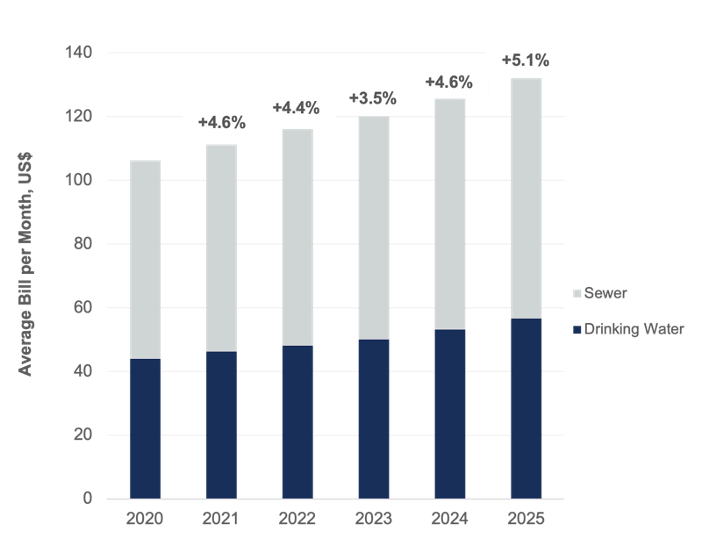
Household water and sewer bills in the United States rose 5.1% in 2025, reaching a five-yearhigh and outpacing inflation, according to Bluefield Research. The firm’s annual US Municipal Water and Sewer Rate Index, which benchmarks utilities across 50 cities, shows a cumulative increase of 24.2% over the past five years, underscoring intensifying financial pressure on both utilities and consumers.
Price increases diverged across services. Drinking water rates rose 6% between 2024 and 2025, compared with a 4.8% increase in wastewater charges. Higher water rates reflect rising operating costs, regulatory compliance requirements, and supply-related investments, including imported water, reuse projects, and source water protection. Utilities are also contending with ongoing efforts to reduce distribution losses.
Wastewater tariffs, while increasing more gradually, continue to exceed water charges. On average, sewer bills have been US$19.23 higher per month than water bills over the past five years, reflecting the capital-intensive nature of treatment infrastructure alongside rising energy and labour costs.
“2025 marks a five-year high for YoY increases in combined water and sewer bills,” said Megan Bondar, analyst at Bluefield Research. “Although rates are rising faster than consumer inflation, utilities are facing their own cost pressures, particularly in maintaining and modernising ageing infrastructure.”
Escalating input costs are a key driver. Utilities are facing higher prices for electricity, treatment chemicals, construction materials, and financing. In Baltimore, Maryland, water treatment chemical costs rose 22% in 2025, while a wastewater construction bid came in 14% above initial estimates. Oklahoma City reported an 85% increase in electricity costs and a 155% rise in chemical expenses, prompting planned rate adjustments. In response, some utilities, including Houston, Texas, are linking tariff revisions directly to inflation.
The trend reflects a longer-term structural shift. Since 2000, the cost of water, sewer, and waste collection services has risen by 207%, compared with 93% for overall inflation. Affordability pressures are becoming more pronounced: the average household now requires 11.5hrs of minimum-wage labour to cover monthly water and sewer bills.
Utilities are taking steps to mitigate the impact on consumers. Cities such as Seattle, San Antonio, and Philadelphia have introduced customer assistance programmes, including discounted tariffs, lifeline rates for essential usage, and targeted financial support based on income or demographic criteria. Others, including Fort Worth, Cleveland, and Portland, have increased transparency through detailed public reporting on revenue allocation.
“Gradual rate adjustments can help ease public concern and build consumer trust,” Bondar said, noting that five of the 50 utilities analysed reported flat or declining rates.
Regional disparities remain significant. Households in the Northeast estimated at $147 and West estimated at $143 face the highest average monthly bills. In the West, utilities are prioritising climate resilience investments such as flood protection and seismic upgrades. In the Northeast, ageing infrastructure, water quality concerns, and higher energy costs continue to drive spending.
“Utilities face difficult trade-offs between maintaining reliable service and ensuring affordability,” Bondar added. “With ageing assets, rising costs, and increasing regulatory demands, there is little indication that upward pressure on tariffs will ease in the near term.”