

By: Nicole Nally, Aquatic Informatics regional manager for Oceania and Asia
The New York City water supply system delivers drinking water to nearly half the US state’s population, serving over 8.5 million residents in the city and an additional 1 million people in upstate counties. Fed by the Catskill/Delaware System — one of the world’s largest unfiltered surface water networks — the system draws from 19 reservoirs and three controlled lakes with a combined storage capacity of roughly 570 billion gallons.
Reservoir levels are continuously shaped by a delicate balance of inflows, water diversions for supply, and controlled releases to maintain downstream river health. To manage this complexity, the New York City Department of Environmental Protection (NYCDEP) monitors data from 445 sensor sites at 5 minute intervals.
These stations capture key hydrological and water quality indicators such as water level, dissolved oxygen, temperature, pH, and turbidity. The system is further enriched with inputs from the US Geological Survey and the National Weather Service, all consolidated through the Aquarius platform, widely used by water agencies globally for real-time monitoring, modelling, and analysis.
Given the scale and sensitivity of the network, data quality is critical. However, sensor faults, missing values, maintenance interruptions, and measurement anomalies can introduce errors such as sudden spikes or flatlines. Inaccurate data can cascade into flawed forecasts, inefficient operations, and potential water quality risks, making robust quality assurance essential for operational reliability.
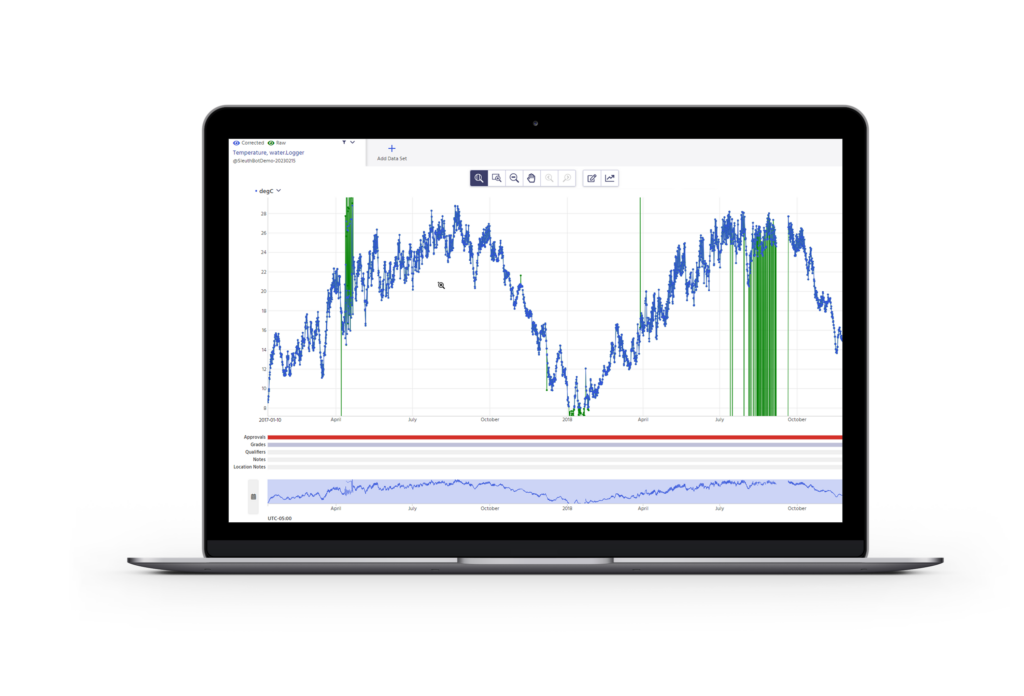
To address this, Aquatic Informatics — developer of Aquarius — partnered with NYCDEP to pilot HydroCorrect, a machine learning (ML)-based QA/QC system designed to detect irregularities and either recommend or automate data corrections. The initiative represents a shift in paradigm from manual data cleaning to human oversight of machine-driven correction.
The pilot began with 11 time series across two known problematic sites: the Shandaken Tunnel Portal — frequent spiking due to sensor faults — and the Rondout Effluent Chamber —persistent flatlines indicating sensor failure. At Shandaken, HydroCorrect learned to distinguish true anomalies from recurring noise, reducing false alerts from continuous spikes to only a few flagged events per week. At Rondout, it successfully applied elevation-based rules to identify and correct flatlined readings, replacing them with interpolated trends that better reflected actual system behaviour.
Within two months, NYCDEP gained sufficient confidence in the system to transition from rule-based suggestions to automated corrections for these sites. As performance improved, the pilot expanded to 60 additional sites covering 200 time series, before eventually being rolled out more broadly across the network.
The system also demonstrated value in real-world operational contexts. In one instance, a turbidity spike from 0.5 NTU to 17 NTU triggered an alert above operational thresholds. Investigation revealed that the anomaly coincided with scheduled maintenance, not a true water quality issue. HydroCorrect incorporated this feedback loop, improving its ability to distinguish operational activity from genuine system irregularities across multiple parameters, including turbidity, temperature, and pH.
Before the pilot, NYCDEP teams were inundated with alerts, requiring manual review of each time series — often 5-20 minutes per dataset — to determine whether anomalies reflected real system issues or data errors. At the outset of the pilot, staff still spent several hours per week refining rules and reviewing outputs. As the system learned, this workload dropped dramatically to approximately 20–30 mins/week, freeing staff to focus on higher-value analysis rather than routine validation.
Importantly, the system has begun surfacing previously unnoticed issues, such as instances of negative flow readings. These discoveries prompted further investigation and the development of new rules to better interpret system behaviour.
NYCDEP’s long-term objective is to scale HydroCorrect to approximately 1,000 time series, with a target of automating up to 90% of data corrections. While human oversight remains essential, the emphasis is shifting toward exception-based monitoring, where staff intervene only when genuinely anomalous conditions arise.
“Reducing personnel hours provides cost savings and improving data quality provides better reporting and decision making, but the software is also about reducing mundane work and enabling NYDEPs’ highly skilled workers to perform higher-value and more engaging tasks,” said Aquatic Informatics account manager Dirk Edwards.