
Investment is shifting from network expansion towards the rehabilitation and replacement of ageing infrastructure, creating new opportunities for pipe manufacturers, contractors and engineering firms.
Municipal spending on drinking water and wastewater pipes across the US and Canada is forecast to total US$99.3bn between 2026 and 2035, according to a new report by Bluefield Research.
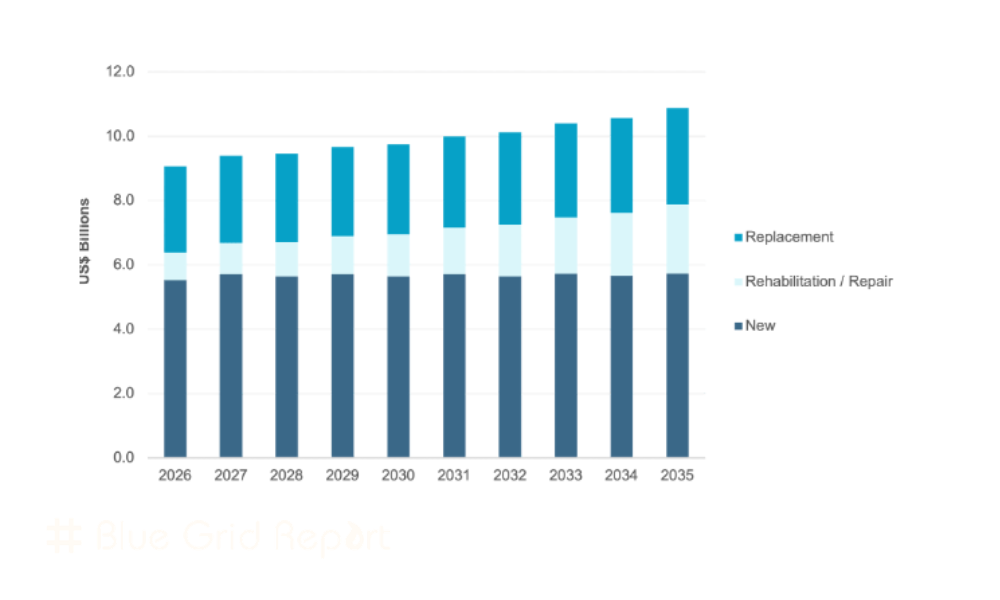
Annual capital expenditure is projected to rise from $9.07bn in 2026 to $10.88bn in 2035, representing a compound annual growth rate of about 2%. While this points to moderate overall expansion, the composition of spending is expected to change as utilities direct more capital towards existing assets.
Rehabilitation and repair are forecast to nearly double their share of total pipe investment, increasing from 9.7% in 2026 to 19.8% in 2035. New construction will remain the largest category by value, but its share of expenditure is expected to decline as replacement needs accelerate.
The shift reflects the age of North America’s extensive installed network, which comprises about 4.52 million miles of water and wastewater pipes. The US accounts for approximately 94% of this infrastructure, with Canada representing the remaining 6%.
Slower housing construction has also weakened demand for new network development. With residential building activity remaining below its 2021 peak, utilities are increasingly prioritising the maintenance and renewal of existing systems.
Distribution and collection pipes already account for roughly 45% of utility capital spending, making them the water sector’s largest infrastructure category.
“That scale makes shifts in utility investment priorities especially important,” said Reese Tisdale, president and CEO of Bluefield Research.
The changing investment mix is expected to influence demand across manufacturing, construction, distribution and engineering services.
Plastic pipes gain market share
Material preferences are also shifting as utilities and property developers seek to control installation and maintenance costs.
Polyvinyl chloride (PVC) is projected to increase its share of total pipe spending from 31.9% to 34.5% over the forecast period. In contrast, ductile iron’s share is expected to decline from 30.3% to 25.9%.
Lower upfront costs, corrosion resistance and easier installation are supporting the use of plastic pipes, particularly in the rapidly growing Sunbelt states. High-density polyethylene and molecularly oriented PVC are also expanding from smaller market bases at a faster rate than conventional PVC.
Ductile iron is expected to retain a position in older and densely developed urban areas, where durability and existing procurement practices continue to shape material selection. Tariff volatility, however, could affect prices and purchasing decisions across all material categories.
Large states anchor spending
Texas, California and Florida are expected to account for about 28% of US pipe expenditure, supported by their large populations and continued development.
Smaller markets may offer stronger rates of expansion. Wisconsin, Utah and British Columbia are each forecast to record annual growth of more than 3%, exceeding the overall market average of 2%.
Regional differences will also influence the types of projects and materials in demand. The Northeast and Midwest have older networks with a greater concentration of legacy materials, while the South and West have younger, more plastic-intensive systems. Although these newer networks require less immediate renewal, the shorter service lives of some materials could bring forward future replacement spending.
Utilities face greater funding responsibility
The investment cycle is unfolding as funding from the Infrastructure Investment and Jobs Act and the American Rescue Plan Act begins to wind down.
Bluefield Research said federal support has had a more limited effect on pipe investment than initially anticipated, partly because funds have taken time to move through state programmes and must also address competing priorities, including emerging contaminants such as PFAS.
Utilities are therefore expected to depend increasingly on rate increases and other financing mechanisms to fund capital programmes. Suppliers that can provide financing flexibility, condition assessment capabilities and sufficient project delivery capacity are likely to be better placed to secure work.
Companies serving pipe rehabilitation, wastewater infrastructure, plastic pipe and larger-diameter transmission projects are expected to benefit most from the changing expenditure profile. Although housing activity, material prices and tariffs could affect the pace of investment, the underlying requirement to replace ageing infrastructure is expected to sustain demand throughout the coming decade.