

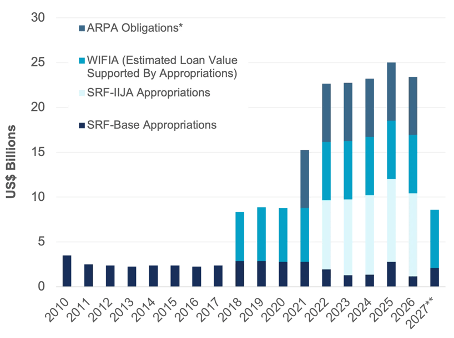
US federal water infrastructure funding is projected to fall by around 63% between fiscal years (FY) 2026 and 2027, from US$23.4bn to an estimated $8.6bn, according to new analysis from Bluefield Research.
However, Bluefield said the headline decline masks differing timelines across the four principal federal funding programmes and should not be interpreted as an equivalent contraction in overall US water infrastructure investment.
Its analysis covers approximately 53,000 projects worth $136bn supported through the State Revolving Fund (SRF), Water Infrastructure Finance and Innovation Act (WIFIA), American Rescue Plan Act (ARPA) and Infrastructure Investment and Jobs Act (IIJA).
The decline largely reflects the expiry of temporary ARPA and IIJA funding rather than the end of federal support for the sector. SRF and WIFIA remain standing programmes, subject to continued congressional authorisation and appropriations.
ARPA presents the most immediate deadline, with unspent funds required to be returned to the US Treasury after 31 Dec 2026. Bluefield found that southern states received more than half of the $39bn in ARPA water infrastructure obligations. Sixteen states, including South Carolina and Mississippi, have secured more water funding through ARPA than through SRF or WIFIA, increasing their exposure as the programme ends.
By contrast, IIJA-backed SRF funding is expected to continue reaching utilities into the early 2030s. Of the $40.7bn allocated to SRF programmes under IIJA, $26.8bn has yet to reach project-level agreements. Bluefield said the outlook for SRF-dependent states will therefore hinge on how quickly this backlog is converted into projects.
WIFIA also remains available beyond 2026, although its use is concentrated among larger borrowers. Bluefield said 21 states have never received a WIFIA loan, while California accounts for 30% of the programme’s total loan value.
The funding transition comes as state and local governments continue to provide the overwhelming majority of US water infrastructure investment. Citing Congressional Budget Office data, Bluefield noted that these governments accounted for 96% of sector investment in 2023, compared with 4% from the federal government.
Policy uncertainty nevertheless remains. Bluefield said congressional earmarks diverted more than half of SRF appropriations in FY2026 towards one-time grants, reducing capital available for revolving loans. Authorisation for both SRF and WIFIA is also due to expire on 30 Sep 2026, while the House has proposed reducing base SRF funding to US$2.1bn for FY2027.
The findings indicate that the end of the recent federal funding surge will affect states and utilities unevenly, depending on their reliance on temporary programmes, access to standing financing mechanisms and ability to move previously allocated funds into active projects.