
The rapid expansion of AI is set to drive €6.8bn in water-related spending across Europe’s data centre sector by 2036, as operators contend with rising cooling demands, mounting water constraints and increasingly stringent regulations.
According to global water market intelligence firm Bluefield Research, the continent’s data centre industry is entering a new phase where access to water is becoming as critical as access to power. Its latest insight report, Europe Water for Data Centers: Market Trends, Opportunities, and Forecasts, 2026–2036, provides an 11-year forecast covering 31 European countries.
The surge in AI workloads is accelerating demand for hyperscale data centres while increasing computing densities and heat generation, placing additional pressure on electricity grids, water resources and permitting systems. As a result, operators are being forced to rethink how facilities are designed, cooled and supplied, with water emerging as a strategic consideration in site selection, project feasibility and long-term operations.
“The rapid scaling of AI and hyperscale computing is reshaping how digital infrastructure and water systems interact across Europe,” said Zineb Moumen, analyst at Bluefield Research. “Water is becoming a critical design, operational, and permitting consideration that increasingly influences where and how data centres are built.”
Bluefield projects that around 62% of cumulative spending will be directed towards capital investments, including cooling systems, water treatment and reuse infrastructure, municipal water connections and pretreatment facilities. Under its baseline scenario, cumulative water-related expenditure will total €6.8bn by 2036, rising to €7.1bn under an accelerated AI growth scenario with more favourable permitting conditions. Even under a slower-growth outlook, spending is expected to reach €4.7bn.
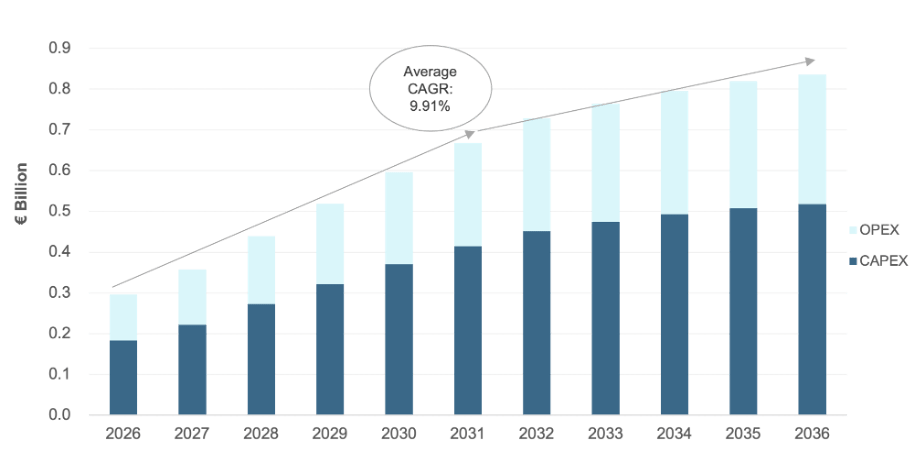
The investment outlook reflects a sector facing tightening regulatory and physical constraints. New EU reporting requirements on power and water consumption are converging with stricter local permitting regimes, growing regional water stress and increasingly constrained energy systems. Together, these factors are making water availability a decisive factor in determining where new data centres can be developed.
“As capital intensity and resource pressures rise across Europe’s data centre market, the investment case for water infrastructure is becoming impossible to ignore,” Moumen said. “The most durable opportunities will arise from infrastructure solutions that not only facilitate project development but also help secure permits, operate efficiently, and scale over time.”
Germany, the UK and France are expected to account for 40.5% of cumulative water-related spending through 2036. However, future expansion in these established markets will increasingly depend on grid capacity, permitting requirements, energy efficiency targets and heat reuse obligations. Meanwhile, growth is expected to accelerate across Spain, Italy, Poland and the Nordic countries, although each market faces distinct challenges ranging from water scarcity and land-use planning to grid modernisation and sustainable cooling strategies.
Beyond direct water consumption for cooling, the report highlights a less visible but growing challenge: the water embedded in electricity generation. Bluefield estimates that indirect water use associated with powering Europe’s data centres will increase by 30% over the next decade. Countries with greater reliance on thermal power generation, such as Germany, face higher indirect water exposure than markets with lower-carbon electricity mixes, including Austria, Sweden and Denmark.
The interconnected nature of Europe’s electricity system further complicates this picture, with data centres drawing power from a mix of nuclear, hydroelectric, natural gas, renewable and imported electricity. Recent heatwaves have already demonstrated the vulnerability of these energy systems, as higher river temperatures curtailed nuclear generation capacity in several markets.
“The indirect water footprint tied to electricity is the exposure most operators are not yet pricing into their planning,” Moumen added. “As AI workloads scale and server densities increase, operators will need to understand not only how many megawatts they can secure, but what water exposure is embedded within those megawatts.”
The report also identifies liquid cooling as a defining technology shift for the sector. As AI drives higher server densities and thermal loads, liquid cooling is expected to account for around one-fifth of Europe’s data centre cooling market by 2036. This transition is reshaping competition across cooling, water treatment and digital infrastructure, prompting infrastructure providers like Ecolab and Vertiv to expand beyond standalone products towards integrated platforms that combine cooling technologies, water treatment and system optimisation.
“Europe’s data centre market is entering a phase where cooling can no longer be provided as a standalone system,” Moumen said. “As AI deployments scale, operators must manage the entire thermal ecosystem — from liquid cooling and water quality to utility integration and operational performance. The companies best positioned for growth will be those that can deliver these capabilities as an integrated solution.”