North America’s municipal water sector is entering a new phase of digital transformation, with utilities moving beyond pilot projects and isolated deployments toward integrated, system-wide digital infrastructure.
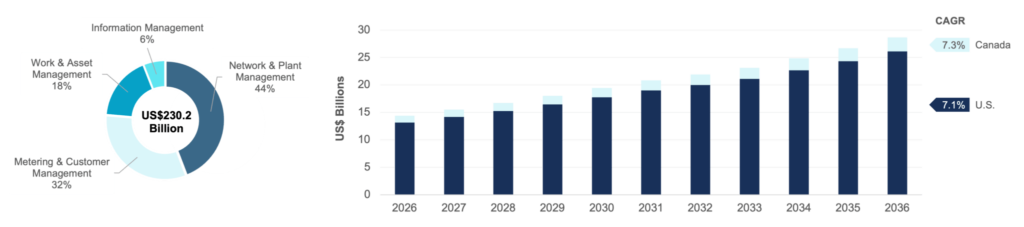
According to Bluefield Research’s report, US and Canada digital water landscape: Trends and growth forecasts, 2026–2036, annual spending on digital water solutions is projected to grow from US$14.4bn in 2026 to $28.6bn by 2036. Cumulative spending over the next decade is expected to reach $230bn, reflecting a 7.1% compound annual growth rate (CAGR).
The forecast highlights how mounting infrastructure challenges — including ageing assets, water scarcity, regulatory pressures, and operational inefficiencies — are accelerating investment in digital technologies across the water sector.
Advanced metering infrastructure (AMI) continues to gain momentum, with smart meter deployment projected to grow at a 9.7% CAGR. Utilities are increasingly viewing smart meters as more than billing tools, leveraging real-time data to improve leak detection, demand management, and network visibility.
Asset management is expected to be one of the largest growth areas, expanding from $2.3bn to $5.5bn by 2036. Technologies such as drones, condition assessment platforms, and digital inspection tools are helping utilities transition from reactive maintenance strategies to predictive, risk-based infrastructure management.
Leak detection is also emerging as a critical investment priority. As utilities grapple with drought conditions, population growth, and non-revenue water losses, spending in this segment is forecast to nearly quadruple over the next decade. Utilities are increasingly combining field inspections with sensor-based monitoring systems to identify and address leaks more proactively.
Meanwhile, wastewater utilities are accelerating digital adoption to strengthen system resilience. Bluefield projects wastewater-related digital investment will increase from $1.2bn in 2026 to $2.8bn by 2036 as operators seek to reduce overflow risks, improve network monitoring, and better manage ageing infrastructure.
As connected infrastructure expands, cybersecurity and information management are becoming increasingly important. Cybersecurity spending is forecast to nearly double over the coming decade, while information management is expected to be the fastest-growing digital water product category, driven by rising data volumes and evolving regulatory requirements.
The report suggests the next stage of digital transformation will depend not only on deploying new technologies, but also on integrating data and intelligence across utility operations. Utilities that successfully connect traditionally siloed systems are likely to be better positioned to improve resilience, optimise investments, and respond to growing operational challenges.