
The US municipal biosolids management market is projected to reach $4.8bn by 2035, as growing scrutiny of PFAS adds uncertainty to wastewater utilities’ management and disposal strategies.
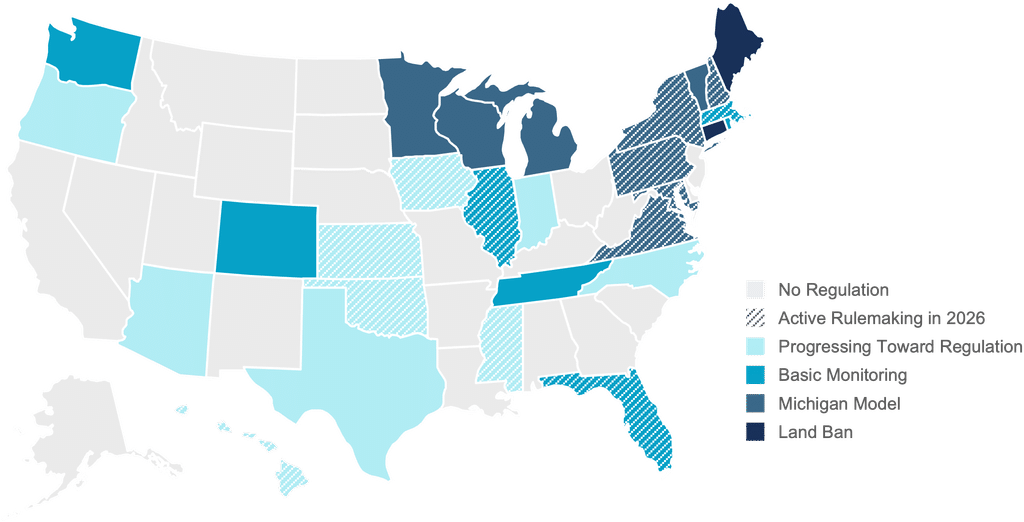
With no federal PFAS standard for biosolids currently in place, states are pursuing different regulatory approaches, creating a patchwork of requirements that is influencing industry spending and disposal decisions.
“The traditional models for biosolids management in the US, including landfilling and landspreading, are under increasing pressure. Growing public awareness of PFAS in biosolids, increasingly stringent drinking water standards, and state-level regulatory activity are bringing greater scrutiny to conventional management practices,” said Pat Byrne, an analyst at Bluefield Research.
Bluefield Research’s report — PFAS Management of Municipal Biosolids: A Shifting Regulatory Landscape — examines how policy and economic changes are shaping local decisions. PFAS concerns are introducing costs and complexities that were not anticipated a decade ago.
States take different approaches to PFAS in biosolids
States are pursuing three main approaches to PFAS in land-applied biosolids: monitoring requirements, concentration-based restrictions and outright bans on land application. Regulatory developments remain uneven across the country.
Twenty-two states have no PFAS biosolids regulations or clear movement toward introducing them. Among states with existing frameworks, differences in testing methods, concentration limits and land-application restrictions create compliance challenges for utilities and service providers operating across state lines.
In 2026, proposed bans in Massachusetts, New York and Hawaii failed to advance, while tiered restriction models passed in Maryland, Virginia, New Hampshire and Pennsylvania. These models generally permit land application at lower PFAS concentrations while imposing tighter requirements as concentrations rise. Initial restrictions in states adopting tiered approaches often begin at concentrations of 20–25 parts per billion (ppb).
“Legislatures and executive agencies in more than half of US states have implemented or appear to be seriously considering new regulations for PFAS in land-applied biosolids,” said Byrne. “This represents an unusual level of regulatory activity for the sector.”
PFAS rules shift spending toward compliance and disposal
Regulatory uncertainty complicates utilities’ capital and operating expenditure planning. Bluefield Research’s analysis points to growing demand for testing, source control, dewatering and hauling services as utilities seek to manage disposal costs while retaining flexibility in their management options.
“Tiered restrictions may offer a more practical alternative to blanket bans, but they also heighten the need and cost for testing, compliance support, and measures to limit PFAS from entering wastewater systems,” added Byrne.
Larger biosolids management companies with access to disposal sites in lower-cost, less restrictive states may be better positioned to navigate the changing landscape. However, differences in state requirements introduce additional compliance costs and operational complexity, potentially offsetting some of these advantages.
Future spending will depend largely on whether states continue to permit land application under defined conditions or require utilities to adopt alternative disposal methods.
Land application remains the dominant pathway
Despite increasing scrutiny, land application remains central to US biosolids management. It offers a relatively low-cost disposal route while returning nutrients and organic matter to the soil, and no alternative is currently positioned to replace it at scale.
Landfilling faces constraints related to material moisture and tipping fees, while incineration capacity remains limited. Only 56 US wastewater treatment plants (WWTPs) operate sludge incinerators, concentrated largely in the Northeast and Midwest. Emerging technologies such as pyrolysis and gasification offer potential alternatives but remain expensive and have yet to achieve widespread commercial adoption for biosolids management.
“It is important to recognize that PFAS regulations are not eliminating land application or causing an overnight transformation of municipal biosolids management,” said Byrne. “Land application may become more restricted and costly for some utilities, but it is likely to remain an important management pathway for the foreseeable future.”
As states refine their approaches to biosolids management, utilities and service providers will need to balance compliance requirements against the economics of available disposal options. In the near term, market opportunities are likely to center on PFAS testing, risk management and cost control, alongside solutions that preserve flexibility across disposal pathways.